The true story · Read No. 04
Tyson v Douglas
The Night No One Can Forget
15 minute read
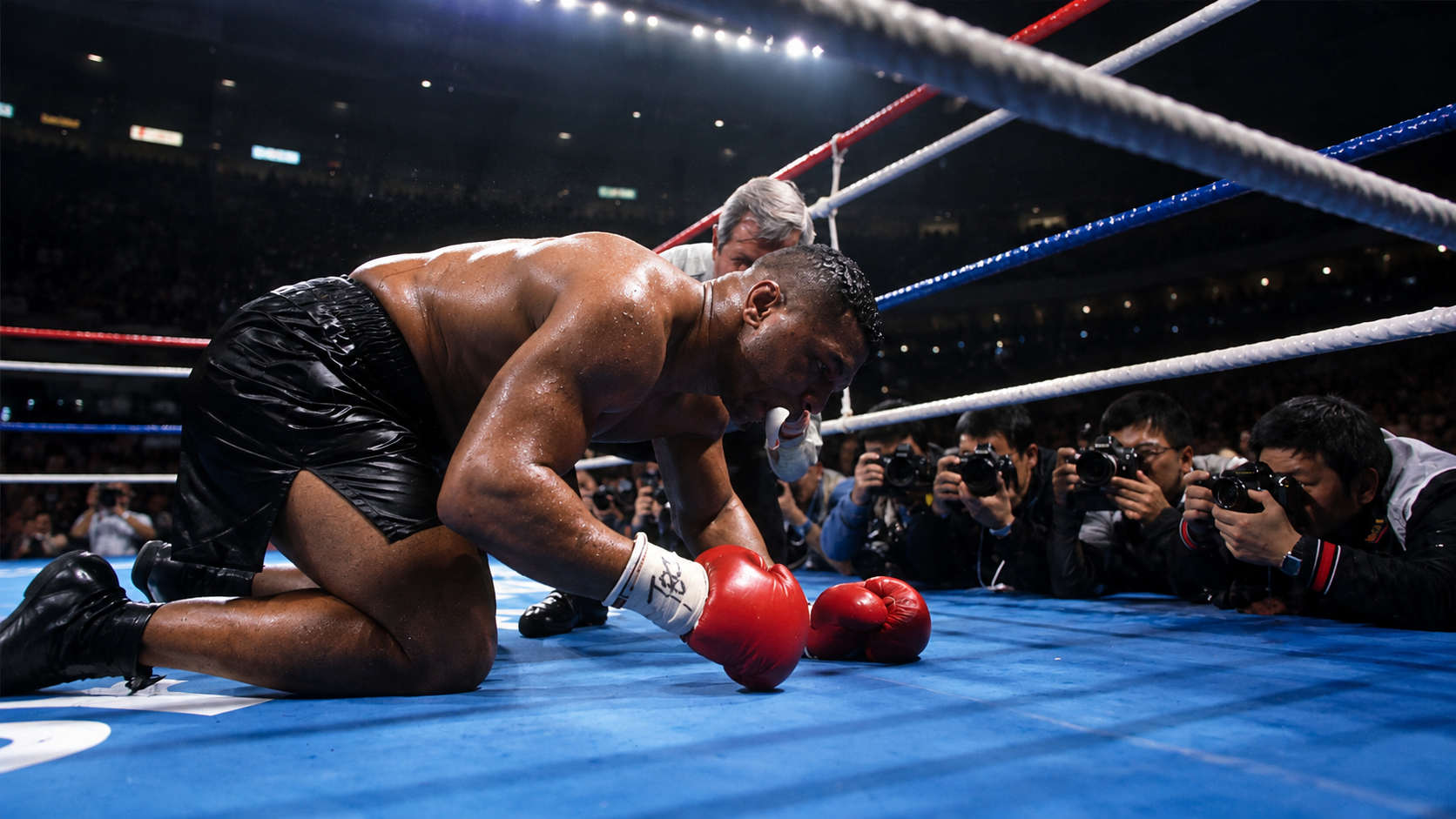
Tokyo, 11 February 1990. Mike Tyson was 23, 37-0 and undisputed. Ten rounds later he was on his knees looking for his mouthpiece.
Mike Tyson was not supposed to lose. Trevor Berbick had been overwhelmed, Larry Holmes stopped, Michael Spinks destroyed in 91 seconds. His fights had become less about who would win than how long the other man could survive.
James “Buster” Douglas was supposed to be another stop before something bigger. Evander Holyfield was waiting and a huge Tyson-Holyfield fight was being planned. Instead, before roughly 30,000 people at the Tokyo Dome, a routine defence became one of the most remembered nights in sport.
Douglas did not survive Tyson. He outboxed him, hurt him, was knocked down himself, rose, took control again and knocked Tyson out in the tenth. The fight is routinely called boxing's greatest upset, but that phrase can make it sound accidental. It was not. Contemporary punch statistics credited Douglas with landing 230 punches to Tyson's 101, including 128 jabs to Tyson's 23.
This was a sustained beating interrupted by one terrifying uppercut in the eighth. What happened after that knockdown is why Tokyo still matters. For one morning, almost every assumption the sport had made about both men turned out to be wrong.
★ Tokyo 1990 ★
How Tyson Became Inevitable
Tyson had become the youngest heavyweight champion in history when he stopped Trevor Berbick in 1986 at twenty. Under Cus D'Amato's system and trainer Kevin Rooney, he developed a compact style built on head movement, explosive entries and combinations delivered from unusual angles. The technique mattered. So did fear. Tyson was short for a heavyweight but moved with extraordinary speed, slipping jabs while advancing, exploding from a crouch, attacking body and head before opponents could reset.
By 1988 he had unified the heavyweight championship and then met the unbeaten Michael Spinks. Spinks lasted 91 seconds. That result turned Tyson from a dominant champion into something approaching myth. Opponents appeared beaten before the opening bell.
But the Tyson who travelled to Tokyo no longer had the same structure around him. D'Amato had died in 1985. Rooney was gone after Spinks. Tyson's personal life was chaotic and the disciplined habits of his early championship years were becoming less consistent. None of it seemed important while he kept winning. After Tokyo, it would look important indeed.
★ Tokyo 1990 ★
Who Was Buster Douglas?
Douglas was not an unknown pulled from obscurity. He was 29, 6ft 4in, from Columbus, Ohio. His father, Billy “Dynamite” Douglas, had been a professional fighter. Buster had obvious gifts: height, reach, a strong jab, a good right hand and fluid movement for a large heavyweight. The problem was consistency. He could look excellent and then strangely passive.
He had already fought for a heavyweight championship in 1987, against Tony Tucker for the vacant IBF title. Douglas boxed well before Tucker stopped him in the tenth. The defeat reinforced a suspicion: he had ability, but did he have the mentality to finish a major fight?
By 1990 his record was 29-4-1. He had beaten Trevor Berbick and Oliver McCall, serious heavyweights, yet almost nobody regarded him as a genuine threat. One Las Vegas sportsbook famously made Tyson roughly a 42-1 favourite. Most casinos considered the fight so one-sided they did not bother posting odds. Douglas knew how he was viewed. His camp believed anyway.
★ Tokyo 1990 ★
A Family In Crisis
“It is a motivation, not a distraction.”
The weeks before the fight were brutal for Douglas in ways that had nothing to do with Tyson. His mother, Lula Pearl, died suddenly on 18 January 1990, just over three weeks before the contest. The mother of his eleven-year-old son Lamar was seriously ill. Douglas and his wife had separated.
Two days before the fight he told reporters: “Nothing compares to these last few months in the life of James Douglas.” Asked whether the turmoil was distracting him, he answered: “It is a motivation, not a distraction.”
That should not be romanticised. Grief does not automatically make an athlete stronger, and Douglas could easily have been broken by what was happening around him. Instead it seemed to narrow his focus. His mother had believed he could win. Douglas went to Tokyo determined to prove her right.
★ Tokyo 1990 ★
Tyson's Fight Before The Fight
Tyson's preparation moved in the opposite direction. After the defeat, in his first extended interview, he admitted: “I never took the fight seriously.” He said he had developed “sloppy habits” because previous opponents had been beaten even when his preparation was imperfect. He described letting his weight climb and then losing around 25 pounds during his final weeks in Japan.
There were warning signs. Tyson was knocked down by sparring partner Greg Page during a public workout. One sparring knockdown proves little, but in retrospect it became part of the evidence that he was not sharp.
The larger issue was technical. The disciplined Tyson of the Rooney years had been difficult to hit while advancing. In Tokyo his head movement was less consistent and he increasingly searched for single explosive punches. Against most heavyweights that remained enough. Douglas was about to make him pay for it.
★ Tokyo 1990 ★
Tokyo Did Not Feel Like History
The fight took place at the Tokyo Dome in the middle of the day in Japan so it could reach the American television audience. Tyson had already fought successfully in Tokyo, stopping Tony Tubbs there in 1988. Yet this did not feel like a defining night. Evander Holyfield was ringside. The expected story was Tyson disposing of Douglas and moving towards the real event.
That assumption shaped how the opening rounds were interpreted. When Douglas jabbed well, people wondered how long he could maintain it. When he landed clean right hands, viewers waited for Tyson to retaliate. The possibility that Douglas was simply the better fighter that day took time to become believable.
★ Tokyo 1990 ★
The Challenger Stops Behaving Like A Challenger
Douglas began with the jab. He was taller, had the longer reach and used both. He moved, jabbed and stopped Tyson establishing the punching distance from which his hooks and uppercuts were devastating. More importantly, he punched with authority. Contemporary reporting noted a right uppercut in the first round that snapped Tyson's head back.
Through the early rounds he circled away from Tyson's right hand. Then he began standing his ground. It was dangerous, but Douglas had discovered that Tyson could be hit repeatedly before getting into his own range. A long straight right in the fourth sent sweat spraying from Tyson's head.
By the middle rounds Tyson's left eye was swelling and he was fighting in bursts rather than controlling the contest. At ringside Holyfield saw it. His promoter Dan Duva later recalled Holyfield saying in the seventh that Douglas wanted to become heavyweight champion and did not care who the opponent was. Everyone else saw Mike Tyson. Douglas increasingly saw a tired man he could hit.
★ Tokyo 1990 ★
The Eighth Round
For all Douglas had accomplished, Tyson remained dangerous enough to erase it with one punch. Late in the eighth, Douglas became momentarily stationary. Tyson fired a right uppercut. It landed cleanly and Douglas fell backwards.
For millions watching, the scene suddenly made sense again. This was the Tyson story everybody knew. The opponent had boxed well, perhaps embarrassed him, but eventually Tyson had found him.
Douglas sat on the canvas, visibly angry with himself. Referee Octavio Meyran counted. Douglas watched him and rose at nine. The bell sounded almost immediately. The upset had survived by seconds. Then came the argument that nearly overwhelmed the fight itself.
★ Tokyo 1990 ★
The Long Count
Video showed that the official timekeeper outside the ring had begun counting before Meyran picked up the count inside. Because Meyran started late, Douglas was physically on the canvas for more than ten seconds. Don King seized on the discrepancy and Tyson's camp argued that Douglas had been knocked out first. The WBA and WBC temporarily withheld recognition; the IBF recognised Douglas.
But boxing's rule is not simply ten seconds on a stopwatch. The fighter responds to the referee. Veteran referee Mills Lane explained afterwards: “Once the ref picks up the count, that's the official count.” Douglas could not be expected to ignore Meyran in favour of a timekeeper he could not see. The video also shows him conscious, watching the referee and timing his rise.
The controversy was real. The claim that it proved Douglas had been knocked out is much weaker. And Douglas then made the argument feel almost irrelevant. He came out for the ninth and resumed beating Tyson.
★ Tokyo 1990 ★
Round Nine: The Real Measure Of Douglas
The ninth may be the most important round in understanding why this fight remains extraordinary. Douglas had just been knocked down by Mike Tyson. He had the perfect psychological excuse to retreat, hold and survive. Instead he attacked.
Douglas hammered Tyson with combinations. Tyson's swollen left eye deteriorated further. The champion who had once stalked heavyweights with terrifying certainty was being forced backwards and made to hold.
The old criticism of Douglas had centred on what happened when a fight became difficult. Against Tucker he had faded. Against Tyson, the most difficult moment of his career produced his strongest response. By the end of the ninth, Tyson's left eye was effectively closed. He still had power. What he no longer had was control.
★ Tokyo 1990 ★
1 Minute 23 Seconds
Tyson on his knees, searching for his mouthpiece while the count moved beyond him.
The tenth began with Douglas still using the jab. Then came the sequence that changed heavyweight history. Douglas landed an uppercut that snapped Tyson's head violently upwards. The champion was badly hurt. Douglas followed with a rapid combination before Tyson could reset. Tyson fell.
It was the first knockdown of his professional career. His mouthpiece came out as he hit the canvas. Tyson rolled, reached for it and tried to put it back into his mouth while getting to his feet. He made it upright, but too late and in no condition to continue.
Meyran stopped the fight at 1 minute 23 seconds of the tenth round. James “Buster” Douglas was heavyweight champion of the world. The dominant emotion was not celebration so much as disbelief. Mike Tyson had lost.
★ Tokyo 1990 ★
This Was Not One Lucky Punch
The numbers protect Douglas's performance from being reduced to a freak result. Contemporary figures credited him with landing 230 punches to Tyson's 101. Douglas landed 128 jabs; Tyson landed 23.
Those are not the numbers of a fighter who survived long enough to stumble across a knockout. Douglas controlled distance, won rounds, damaged Tyson's eye, survived the champion's best punch and then stopped him.
Even the official cards could not disguise the visual reality, although one judge remarkably had Tyson ahead after nine rounds. Ringside observers generally saw a far more decisive Douglas performance. The fight is famous for the result. It deserves to be remembered for the performance.
★ Tokyo 1990 ★
For His Mother
In the minutes after the knockout Douglas looked almost stunned by what he had done. Then somebody asked about his mother. The emotion broke through. “This was for my mother,” he said. “God bless her heart.” He cried.
The contrast was extraordinary. Minutes earlier he had stood in front of Tyson, absorbed a knockdown, returned fire and knocked out the most feared fighter in boxing. Now he was struggling to speak about Lula Pearl.
Asked whether he had been afraid, Douglas said: “I wasn't afraid of the man.” He said the only one he feared was God. Before the fight the words could have sounded theatrical. Afterwards they sounded like an explanation. He won because, on that day, he behaved as though Tyson's reputation belonged to everybody else.
★ Tokyo 1990 ★
Tyson After Tokyo
Tyson initially maintained he had been treated unfairly by the count controversy. With time his explanation moved towards preparation. Easy victories, he admitted, had allowed him to develop sloppy habits, and this time he had picked the wrong opponent.
That admission helps avoid two misleading extremes. Tyson was not at his best in Tokyo, and his technical decline mattered. But saying he was underprepared does not make Douglas's victory accidental. Great upsets usually require two stories to meet: the favourite falling below his level and the underdog rising far above expectation. Tokyo contained both.
Tyson remained dangerous afterwards. He knocked out Henry Tillman and Alex Stewart later in 1990 and regained heavyweight titles in the 1990s. But he was no longer invincible. Every future opponent had film showing a taller heavyweight controlling him with a jab, tying him up, landing straight right hands and refusing to collapse after being hurt.
★ Tokyo 1990 ★
Douglas's Difficult Reign
The new champion's story did not become a fairy tale. Douglas returned to the United States as one of the most famous athletes in the world and Columbus celebrated him. His first defence came eight months later against Evander Holyfield in Las Vegas.
The contrast with Tokyo was striking. Douglas weighed considerably more and did not reproduce the same sharpness or urgency. Holyfield, disciplined and technically precise, knocked him out in the third after Douglas threw an uppercut and was countered by a right hand. The reign had lasted one fight.
That short reign became ammunition for people who wanted to dismiss Tokyo as a freak event. Douglas has always resisted being reduced to a one-hit wonder, pointing out that he had been a world-class heavyweight before Tyson. The Holyfield defeat does not invalidate Tokyo. Douglas did not discover a permanent new level. He reached it once, on the exact night when reaching it changed boxing history.
★ Tokyo 1990 ★
What Douglas Did Technically
His jab was the foundation. Because he was taller and longer he could touch Tyson before Tyson reached punching range, and he did not merely flick it. He committed to it, snapping Tyson's head and disrupting his rhythm.
The right hand followed naturally. Tyson's declining head movement left him on the centre line more often than in earlier championship fights, and Douglas repeatedly drove straight punches through the opening. When Tyson did get close, Douglas often tied him up rather than giving him the uninterrupted combinations he wanted. Then the referee separated them and Tyson had to begin the approach again.
Douglas also used uppercuts intelligently. A shorter fighter moving forward is vulnerable to that punch when his head comes between an opponent's shoulders. The final knockdown sequence began with precisely that weapon. Nothing about the plan was revolutionary. Executing it against Mike Tyson for ten rounds was.
★ Tokyo 1990 ★
Why Tokyo Survives
Many famous fights are remembered because two great champions produced sustained drama. Tyson-Douglas is remembered for something different: it changed reality faster than the audience could adjust to it.
Round by round, viewers waited for the familiar ending. Douglas wins the first? Tyson will catch him. Douglas's jab is working? Tyson will get inside. Tyson's eye is closing? One punch can still end it. Then the uppercut in the eighth appears to confirm every expectation. Douglas gets up. He wins the ninth. He knocks Tyson out in the tenth. The fight repeatedly invites the old story to return and repeatedly refuses it.
No screenwriter needed to invent the dead mother, the 42-1 odds, the supposedly invincible champion, the knockdown, the disputed count or the mouthpiece. They happened. That is why the night still feels unbelievable even when you know the ending.