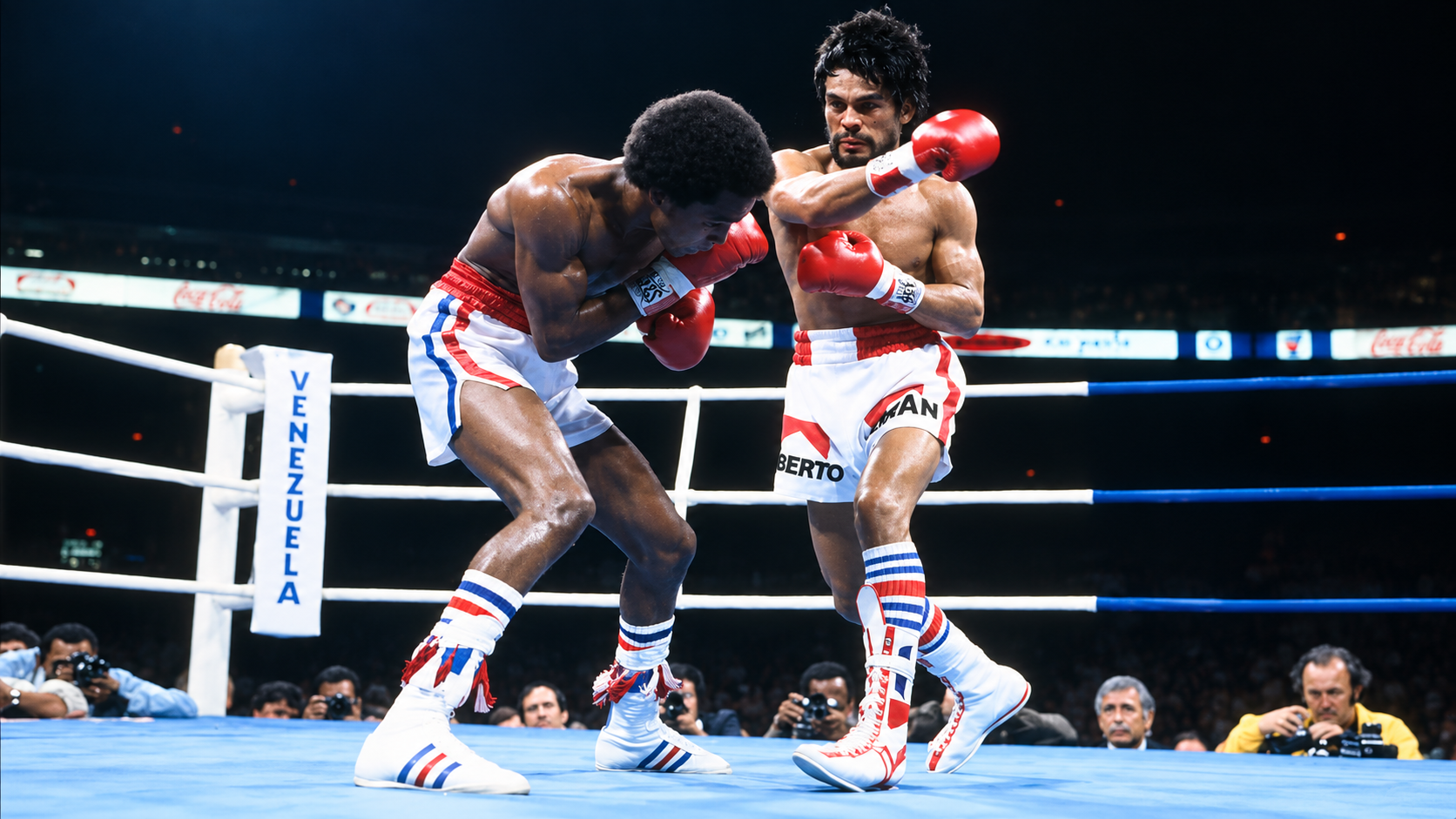
The rise, fall and extraordinary return of a fighter who refused to be defined by one night.
There is a temptation, when writing about Roberto Durán, to begin in New Orleans. Two words, whether he actually spoke them or not, have followed him for more than four decades. “No Más” became one of boxing's most durable pieces of shorthand: the night the frightening Panamanian who seemed incapable of surrender simply turned away from Sugar Ray Leonard and stopped fighting.
But beginning there gives the moment too much power. Durán had already lived an extraordinary boxing life before November 1980, and what happened afterwards was stranger still. He came from poverty in Panama, became the dominant lightweight of his generation, moved up and defeated Leonard at welterweight, then watched his reputation collapse in a matter of months. He was written off, returned to win another world title, pushed Marvin Hagler through fifteen difficult rounds, was flattened by Thomas Hearns, drifted towards irrelevance and then, at 37, defeated the younger and naturally larger Iran Barkley for a middleweight championship.
By the time he finally stopped, Durán had fought professionally from 1968 to 2001. The International Boxing Hall of Fame records 119 contests: 103 victories, 16 defeats and 70 knockouts. He won recognised world championships in four weight divisions and appeared professionally in five different decades.
Those figures tell us how long he fought. They do not explain why people still talk about him. Durán was not simply a violent fighter, although violence was central to his appeal. He was an unusually intelligent one. He could be crude when it suited him, subtle when he needed to be, and psychologically unpleasant almost all the time.
That is the real Roberto Durán story. Not a straight ascent to greatness, and not a morality tale about quitting. It is a story about appetite in every sense of the word: for food, money, recognition, confrontation and boxing itself. Above all, it is about a man who repeatedly reached what looked like the end and refused to remain there.
★ Roberto Durán ★
The Boy From El Chorrillo
Roberto Durán was born on 16 June 1951 in Panama and grew up in El Chorrillo, a crowded working-class district of Panama City close to the Canal Zone. Later accounts of his childhood often emphasised hunger and street fighting, sometimes with the exaggeration that attaches itself to famous fighters, but the poverty was real. He grew up in a household where money was scarce and where toughness was useful long before it became marketable.
Boxing offered structure to instincts he already possessed. He learned young, developed quickly and turned professional on 23 February 1968, still only sixteen. That date is worth keeping in mind. Durán was already fighting for money while Muhammad Ali was exiled from boxing and Joe Frazier was still establishing himself as the leading heavyweight of the period. More than three decades later, Durán would still be fighting when Lennox Lewis was heavyweight champion.
The nickname came early and stayed forever: Manos de Piedra, Hands of Stone. It was memorable and deserved, but it also encouraged a misunderstanding. Durán was not merely a puncher who overwhelmed people through force. Under experienced trainers including Ray Arcel and Freddie Brown, he became a craftsman at close range.
He learned to move an opponent's arms, position his head beside a shoulder, shift weight at the instant a punch came back and create punching room where none seemed to exist. At his best, his defence was measured in inches rather than steps. That economy made the aggression more oppressive. The famous ferocity was real; so was the calculation beneath it.
★ Roberto Durán ★
Buchanan: A Coronation With An Argument Attached
On 26 June 1972, Madison Square Garden held 18,821 spectators for Ken Buchanan's defence of the WBA lightweight championship. Buchanan had the polish of a proven champion. Durán had the momentum of a challenger who seemed increasingly difficult to discourage.
He announced himself immediately. In the opening round, a right hand forced Buchanan to touch the canvas with both gloves. Durán pressed, bumped and worked at close quarters, making the champion fight more often than he wanted. The contest was rough, and Buchanan complained about the challenger's head and low work. None of that prevented Durán from building a substantial lead.
Then came the ending. As the bell sounded to finish the thirteenth round, the fighters continued exchanging. Durán landed a final right hand low. Buchanan collapsed in pain and was unable to continue. Referee Johnny LoBianco stopped the fight and awarded Durán a technical knockout, maintaining that the decisive punch had landed legally in the abdomen. Buchanan insisted for the rest of his life that it had struck him below the belt.
Contemporary medical examination supported Buchanan's claim, and the surviving film has ensured the dispute never disappeared. There is no need to choose between two truths. The ending was controversial and Buchanan had legitimate grounds for grievance. Durán had also been winning the fight clearly before the final punch. At 21, he was lightweight champion of the world.
★ Roberto Durán ★
The Lightweight Years
Winning the title was not the achievement that ultimately made Durán great. Keeping it was. Over the following years he made twelve successful defences of the WBA lightweight championship, eleven of them inside the distance. Jimmy Robertson, Guts Ishimatsu, Ray Lampkin, Lou Bizzarro and Edwin Viruet were among those who tried to solve him.
This was the period in which the legend of Hands of Stone became reality. Durán attacked the body with particular cruelty, but his greatest strength was the way the body attack connected to everything else. A fighter who lowered an elbow to protect his ribs exposed his head. A fighter who stood tall to avoid the hooks downstairs found Durán underneath him. A fighter who tried to hold discovered that Durán was comfortable working with one arm free.
He was not invulnerable. Esteban De Jesús proved that. The Puerto Rican met Durán in a non-title fight in November 1972 and dropped him in the first round before winning a decision — Durán's first professional defeat. They met again in March 1974 with the title at stake. De Jesús again dropped him in the opening round, but this time Durán remained patient, gradually imposed himself and stopped him in the eleventh. A third fight in January 1978 ended with a Durán stoppage in the twelfth.
The trilogy reveals something the image of an unstoppable destroyer obscures. Durán could lose. What made him unusual was his capacity to study a defeat, return to the same opponent and produce a different result.
★ Roberto Durán ★
Leonard: Two Men Who Needed The Other
Leonard had entered professional boxing carrying the glow of the 1976 Montreal Olympics. He was fast, articulate, commercially attractive and technically brilliant. By late 1979 he had stopped Wilfred Benítez to become WBC welterweight champion. Durán represented a different boxing mythology. Leonard appeared polished; Durán cultivated menace.
They agreed to meet on 20 June 1980 at Montreal's Olympic Stadium, the same city in which Leonard had won Olympic gold four years earlier.
Durán began fighting before the bell. He insulted Leonard, mocked him and extended the hostility towards Leonard's family. It was ugly, but strategically useful. Leonard later acknowledged that Durán had succeeded in making the contest personal. That mattered, because Leonard had the tools to make Durán's evening miserable — he was faster, comfortable moving and capable of scoring while refusing prolonged exchanges. Instead he entered Montreal determined to prove he could stand with Durán.
★ Roberto Durán ★
Montreal: The Night Durán Mastered Leonard
The first Leonard-Durán fight is often called the Brawl in Montreal, but the nickname can mislead. It was violent, certainly, but Durán's performance was far more sophisticated than a brawl. From the opening rounds he pressed without rushing, moved his upper body as he came forward, jabbed his way into range and attacked Leonard's body.
At long range Leonard was faster. At close range the balance changed. Durán could position his head, work around Leonard's elbows and punch during the tiny pauses between Leonard's combinations. He made the champion spend energy simply maintaining space. Durán glared, talked and pushed every exchange towards confrontation, refusing to grant Leonard emotional control of the fight.
After fifteen rounds, there had been no knockdowns and little separation. The judges scored it 146-144, 145-144 and 148-147, all for Durán. The scores matter because they remind us this was not domination. It was something more impressive: Durán had beaten an exceptional fighter in a close, high-level contest by persuading him to fight in a way that narrowed his own advantages.
Back in Panama, he returned as a national hero. It should have been the uncomplicated summit of his career. Five months later, it became the prelude to the most damaging night of his life.
★ Roberto Durán ★
Five Months Between Triumph And Disaster
The speed of the rematch is central to what happened next. Leonard had learned in Montreal that he did not need to prove his toughness, and he wanted the second fight quickly. Durán returned to Panama and celebrated. Accounts from Durán, his camp and later biographers describe substantial weight gain after Montreal and a difficult training period before the rematch.
Durán would later insist that he did not have enough time to prepare properly and that making 147 pounds contributed to stomach problems on fight night. Those claims cannot be treated as neutral facts simply because Durán repeated them. Leonard always rejected the idea that physical preparation explained the ending.
What can be said safely is that Durán's condition between fights was a recurring problem throughout his career, and that the rematch came only five months after the first fight. The tactical change was far less ambiguous. Leonard was not going to stand still again.
★ Roberto Durán ★
New Orleans And The Birth Of “No Más”
“The essential fact is visible on film: Durán chose to stop fighting.”
On 25 November 1980, the Louisiana Superdome hosted the rematch. Leonard moved from the beginning. He jabbed, changed direction and refused to remain in front of Durán long enough to be worked over. As the rounds passed, his movement became more theatrical. He dropped his hands, feinted and mocked. In Montreal, Durán had used anger to influence Leonard. In New Orleans, Leonard was returning the favour.
Late in the eighth round, Durán turned away. He gestured with a glove. Referee Octavio Meyran initially seemed uncertain about what was happening. Leonard approached, expecting the contest to continue. Durán indicated again that he was finished.
Within minutes, “No Más” had become the story. The exact words remain disputed. Meyran and contemporary observers said Durán used the phrase. Durán later insisted he never literally said it, and his accounts varied over the years. Ray Arcel, interviewed years later, remained baffled by what he had seen and recalled Durán saying his stomach hurt. There is no honest way to reconstruct every word now, and no need. The essential fact is visible on film: Roberto Durán chose to stop fighting.
For almost any boxer, quitting would have been damaging. For Durán it was catastrophic because of the identity he had built. Leonard had not beaten him senseless. He was not trapped on the ropes absorbing unanswered punches. He simply decided he would not continue. For a time, it looked as though those few seconds would become the final interpretation of everything Durán had been.
★ Roberto Durán ★
The Years When Redemption Did Not Arrive
The neat version of the story has Durán respond immediately by rebuilding himself. Real life was messier. He returned to boxing, but the great lightweight now existed in a heavier body and with an increasingly inconsistent relationship to training.
In January 1982, he challenged Wilfred Benítez for the WBC junior-middleweight title and was outboxed over fifteen rounds. The defeat was respectable. What followed was harder to explain. In September 1982, Durán fought Kirkland Laing in Detroit. Laing was talented but unreliable, a boxer whose career never matched his gifts. Against Durán he produced one of his best performances and won a decision.
Losing to Leonard or Benítez could be explained by elite opposition. Losing to Laing suggested decline. Durán was 31 but had already been a professional for fourteen years. Boxing began to talk about him in the past tense.
Then he stopped former welterweight champion Pipino Cuevas in four rounds in January 1983. Cuevas was past his best, so the win did not prove the old Durán had returned. It did create an opportunity. The WBA junior-middleweight champion was Davey Moore, a 24-year-old New Yorker with only a dozen professional fights.
★ Roberto Durán ★
Davey Moore: The Resurrection Was Not Gentle
The date was 16 June 1983, Durán's thirty-second birthday. The atmosphere at Madison Square Garden favoured the veteran; he had won his first world title in the building eleven years earlier. Durán crowded Moore from the opening round and immediately exposed the difference in experience.
Late in the first round, Moore suffered an injury around his right eye. Moore later complained that Durán had thumbed him, and the eye began swelling badly. The incident remains part of the fight's history and should not be brushed aside — Durán had always been a rough infighter, and opponents frequently complained about the physical liberties he took.
But the injury did not explain the entire fight. Durán systematically broke Moore down, attacking the body and bringing punches upstairs. Moore went down late in the seventh. By the eighth, both eyes were badly swollen and he was taking punishment without changing the direction of the fight. Referee Ernesto Magaña stopped it at 2:02 of round eight.
Three years after the night that was supposed to define him forever, Durán was a world champion again. The victory did not erase New Orleans. What it did was make New Orleans insufficient as an explanation of the man.
★ Roberto Durán ★
Hagler: A Former Lightweight Against The Middleweight King
Marvelous Marvin Hagler was not a convenient opponent for a redemption story. He was the undisputed middleweight champion, physically powerful, technically excellent and in the middle of a formidable reign. On 10 November 1983, at Caesars Palace in Las Vegas, a man who had once ruled at 135 pounds challenged one of the best natural middleweights in the world.
The obvious strategy for Hagler was to make size decisive. Durán refused to cooperate. He did not attempt to recreate the relentless pressure of his youth. He boxed more carefully, countered Hagler's jab with right hands, changed rhythm and made the champion think before committing.
After thirteen rounds, Durán was ahead on two official scorecards and level on the third. Hagler recognised the danger, increased the pressure and won the fourteenth and fifteenth strongly enough to secure a unanimous decision. Durán had lost — but a former lightweight champion had gone fifteen competitive rounds with Hagler. It was the kind of defeat that enlarged rather than diminished a reputation.
★ Roberto Durán ★
Hearns: The Night There Was Nowhere To Hide
Thomas Hearns brought a different physical problem. Tall, rangy and armed with one of the most destructive right hands in boxing history, Hearns could end a contest before tactics had time to mature.
On 15 June 1984, Durán challenged him for the WBC junior-middleweight championship in Las Vegas. The fight was brutally brief. Hearns dropped Durán twice in the opening round. Durán survived to the bell, but there was no meaningful recovery. In the second, Hearns landed a right hand with extraordinary force and Durán fell face-first to the canvas.
For a fighter famous for resilience, the image was shocking. There had been no gradual breaking down, no late-round exhaustion and no controversy. At 33, Durán appeared to have exhausted every possible version of a comeback. For several years, that judgement looked sensible.
★ Roberto Durán ★
The Wilderness Years
Durán did not vanish, but he drifted away from the centre of championship boxing. He fought intermittently, moved through weight divisions and remained famous enough that his name still mattered even when his results no longer demanded attention.
This period is essential to understanding what happened in 1989. The Iran Barkley fight can look, in a list of famous Durán bouts, like another stop in a continuous championship career. It was not. Nearly seventeen years had passed since he took Buchanan's title.
Barkley was 28, a natural middleweight and the reigning WBC champion. He had won the belt by knocking out Thomas Hearns in the third round in June 1988. That fact alone made the comparison uncomfortable: Hearns had flattened Durán; Barkley had flattened Hearns.
There was another layer. Barkley had been close to Davey Moore. The two came from the South Bronx, had sparred together and shared a history. Moore had died in a freak accident in 1988, and Barkley openly spoke of fighting Durán partly in his friend's memory, believing Durán had thumbed Moore in 1983. Durán responded with characteristic lack of sentiment.
★ Roberto Durán ★
Iran Barkley: One More Impossible Night
“It was the victory of an old fighter over time itself.”
They met at the Atlantic City Convention Center on 24 February 1989. Barkley looked like what he was: the natural middleweight. He attacked Durán's body and tried to impose his strength. Durán was no longer attempting to fight like the lightweight destroyer of the 1970s. He had become a veteran who understood how to steal moments, conserve energy and punish predictable aggression.
He repeatedly found Barkley with right hands. Inside, where the larger man might have expected to dominate, Durán used decades of craft to make the exchanges competitive. Barkley had success and hurt him, particularly with body punches. Durán kept returning.
Then, in the eleventh round, a combination finished by a right hand sent Barkley down. Barkley rose, but the knockdown had altered both the scoring and the emotional balance. Two judges had Durán winning, 118-112 and 116-112; the third scored it 116-113 for Barkley. At 37, the former lightweight champion was a middleweight world champion.
The Ring named the contest its Fight of the Year. Durán compared himself to wine, improving with age. He had not literally improved — he was slower and less relentless. What had improved was his ability to survive without those advantages. If Montreal was Durán at his peak, Barkley was the victory of an old fighter over time itself, if only for one night.
★ Roberto Durán ★
Leonard, One Last Time
The Barkley victory inevitably created another major payday, and the name waiting was familiar. Durán and Leonard met for a third time on 7 December 1989, more than nine years after Montreal and New Orleans. Leonard won a clear unanimous decision over twelve rounds.
The third fight never acquired the emotional force of the first two. Perhaps it could not. Montreal had been a genuine collision between two elite fighters at their peak; New Orleans had produced one of the strangest endings in championship history. The third meeting was an epilogue.
Leonard finished the trilogy ahead two fights to one. Durán had already achieved something more important for his reputation than reversing that score. He had made “No Más” only one chapter of his life rather than the final chapter.
★ Roberto Durán ★
Why He Kept Fighting
Most great champions eventually discover that boxing can survive without them. Durán seemed reluctant to test the idea. He fought through the 1990s. There were defeats to Vinny Pazienza, a loss to Héctor Camacho and victories over lesser opposition.
Those late fights did little to improve his historical standing. Yet they reveal something central to his personality. Boxing was not merely the route Durán had taken out of poverty. It was the environment in which he understood himself. A fighter who begins at sixteen does not necessarily develop a clean separation between the person and the profession. Retirement meant more than losing income; it meant giving up the place where his identity made the most sense.
He had turned professional in 1968 and was still boxing in 2001 — appearances in five separate decades. His final professional contest came against Héctor Camacho in July 2001, a unanimous-decision defeat. He was 50 years old.
★ Roberto Durán ★
The Crash That Finally Ended The Career
In October 2001, Durán was seriously injured in a car crash in Argentina. The injuries included multiple broken ribs and serious damage to a lung. His recovery was slow, and the physical consequences made another return increasingly unrealistic. In January 2002 he formally announced his retirement.
There was an irony in the way the career ended. Opponents had been trying to convince Durán to stop for more than three decades. De Jesús had beaten him. Leonard had humiliated him. Hearns had knocked him unconscious. Age had taken speed and reflexes. None of it had permanently separated him from boxing. A road accident finally did.
The International Boxing Hall of Fame records the completed career at 103 victories, 16 defeats and 70 knockouts across 119 contests and more than thirty-three years. The more revealing measure is the distance between the worlds in which he competed. He began as a teenage professional before the first Ali-Frazier fight had even happened, and finished in an era of pay-per-view and Lennox Lewis. He had not merely lasted a long time. He had crossed eras.
★ Roberto Durán ★
The Fighter Beneath The Fury
Durán's historical reputation rests heavily on the lightweight years, and rightly so. The easy description is that he pressured opponents. The more accurate description is that he removed choices. If an opponent moved, Durán cut the ring. If he stood still, Durán worked the body. If he tried to exchange, Durán was comfortable there. If he held, Durán knew how to free a hand and continue punching.
His defence deserves particular attention because it disappears beneath the reputation for violence. Durán could slip punches while moving forward and roll with shots at a range where most fighters simply accepted contact. He did not need to retreat three feet to avoid a punch; sometimes three inches were enough.
He was also psychologically sophisticated. The rage was partly genuine and partly useful. Leonard in Montreal is the clearest example: by making the contest personal, Durán encouraged Leonard to prove his courage rather than exploit his superior movement. The weakness was that Durán could be captured by his own emotions too. Montreal shows Durán's psychological warfare succeeding. New Orleans shows it being used against him.
★ Roberto Durán ★
A Career Full Of Uncomfortable Truths
Admiring Durán does not require turning him into a spotless hero. His career contains rough tactics, disputed incidents, inconsistent preparation and losses that cannot all be explained by age or weight. The Buchanan ending remains controversial. Moore believed he was thumbed. Durán's discipline between fights could be poor. His explanation for New Orleans has never satisfied everyone, including people who knew him well.
Those complications are not obstacles to the story. They are the story. The same appetite that drove him through punishing training camps could lead him towards excess once the fight was over. The same pride that made him refuse to concede physical ground could make frustration unbearable. The same confidence that allowed him to challenge larger champions kept him boxing long after his prime.
His life resists the clean moral arc often imposed on sports biographies. He remained recognisably Roberto Durán throughout: proud, volatile, funny, difficult, gifted and almost pathologically unwilling to believe his time had passed.
★ Roberto Durán ★
More Than “No Más”
There is a strange injustice in the fact that two disputed Spanish words became the most famous phrase associated with Roberto Durán. They matter. The Leonard rematch cannot be removed from his record or softened into something it was not. Durán stopped fighting, and for a champion of his temperament that was astonishing.
But careers have scale. Before New Orleans, Durán had already become a great lightweight and had beaten Leonard in Montreal. Afterwards he became junior-middleweight champion by destroying Davey Moore, pushed Marvin Hagler through fifteen rounds, survived the public humiliation of the Hearns knockout and eventually defeated Iran Barkley for a middleweight title at 37.
A fighter can have a worst night without that night becoming the complete definition of him. Durán proved that more dramatically than almost anyone.
★ Roberto Durán ★
Legacy
Roberto Durán was inducted into the International Boxing Hall of Fame in 2007. By then, time had done what Durán himself spent years trying to do: it had put New Orleans back into proportion.
His career is difficult to make tidy because Durán himself was difficult to make tidy. There were too many versions of him: the hungry boy from El Chorrillo, the terrifying lightweight, the man who conquered Leonard, the man who turned away from Leonard, the ageing champion, the veteran who could not quite leave. Perhaps that is why the story lasts.
The most revealing image is therefore not necessarily the one from New Orleans. It may be Atlantic City in 1989. Durán is 37. Across the ring stands a younger middleweight champion with every physical reason to beat him. The old fighter has already been dismissed several times, and this time the dismissal seems entirely rational. Then the bell rings. In the eleventh, he drops Barkley. When the decision is announced, Hands of Stone is a world champion again.
That is Roberto Durán in full: not unbeatable, not uncomplicated and never entirely finished when everyone else thought he should be. For a few seconds in New Orleans, he appeared to surrender the identity on which his career had been built. He spent the next twenty years proving that a life, and a legacy, can be much larger than its worst night.