The true story · Read No. 05
Jeff Lacy
The night Calzaghe took away Left Hook
14 minute read
Manchester, 4 March 2006. Two unbeaten super-middleweight champions walked into the MEN Arena. Thirty-six minutes later, almost every assumption had changed.
Joe Calzaghe had been WBO champion for more than eight years. Jeff Lacy was 28, American, an Olympian, the IBF champion and one of boxing's most heavily promoted young fighters. His nickname, Left Hook, suited a compact, muscular puncher many Americans believed was the future.
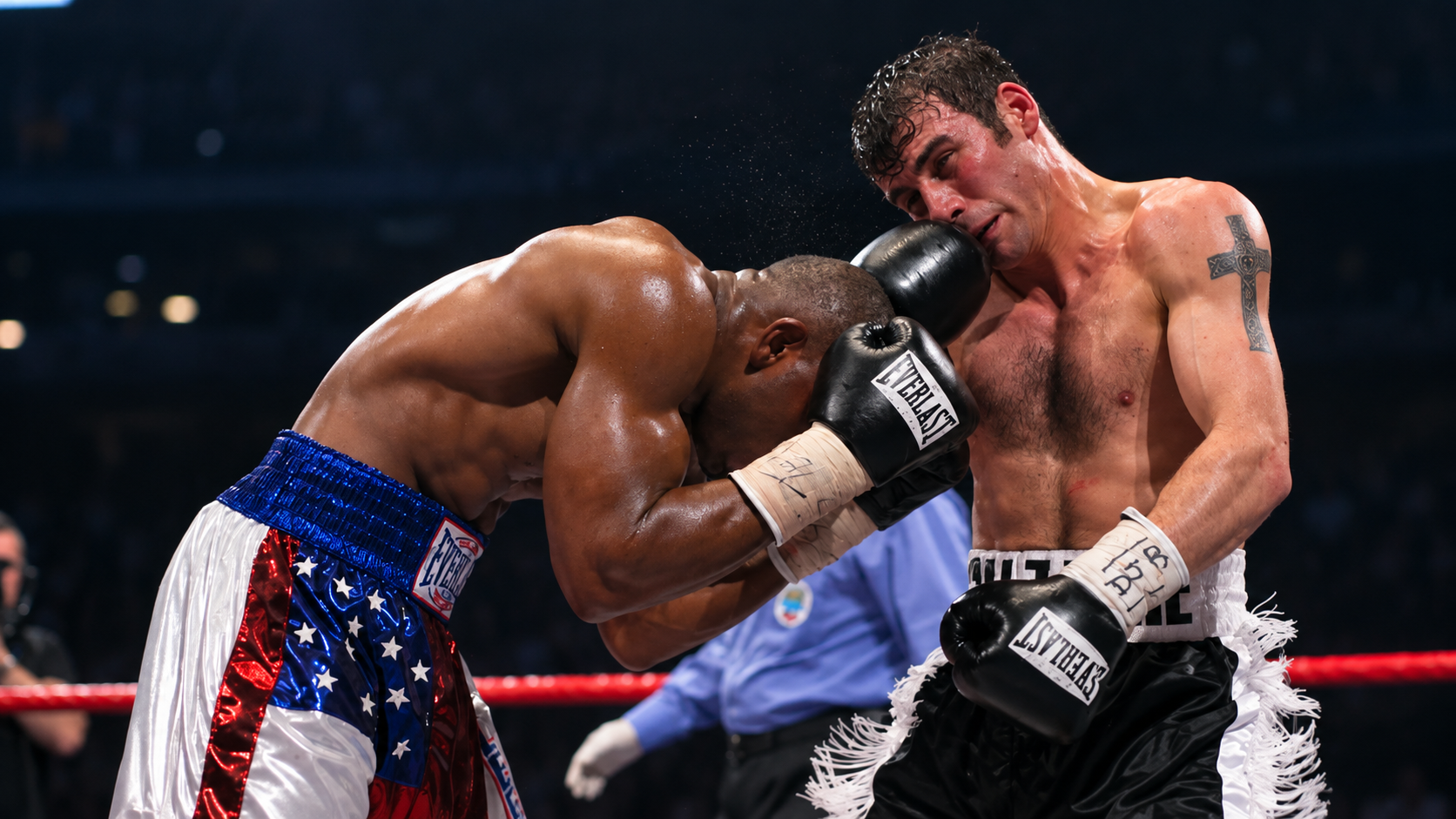
Calzaghe did not merely beat Lacy. He dismantled him. The scorecards — 119-105, 119-107 and 119-107 — barely captured the extent of it. Lacy was outpunched, outthought and dropped in the final round. Calzaghe lost a point in the eleventh, making the cards look closer than the contest.
For Calzaghe, the night opened the door to recognition. For Lacy, it became the night people would use to explain almost everything that followed. The familiar version is simple: Joe Calzaghe ruined Jeff Lacy. The truth is more complicated.
The defeat destroyed Lacy's aura. Nine months later, a serious shoulder injury damaged his most famous weapon. Then came years of trying to discover whether the fighter he had been before Manchester still existed. According to Calzaghe, when the two met again roughly a decade later, Lacy thanked him: “Joe, you took away my ego.” That is where the story becomes much more than a boxing result.
★ Manchester 2006 ★
Before Manchester
Lacy was born in St. Petersburg, Florida, on 12 May 1977. He represented the United States at the 2000 Sydney Olympics and turned professional in 2001. His first eight opponents did not reach the final bell. The nickname Left Hook became a brand because the punch genuinely mattered.
He progressed quickly and won the IBF super-middleweight championship in 2004. By early 2006 he was unbeaten and widely regarded in America as an emerging star. Calzaghe's long WBO reign was respected in Britain but often discounted elsewhere. Lacy appeared to provide the test American observers had demanded.
Lacy had stopped Robin Reid in seven rounds; Reid had previously pushed Calzaghe through a difficult split decision. That comparison encouraged the belief that Lacy's power would expose the Welshman. The hype grew. Lacy was even compared with a young Mike Tyson, a technically loose comparison that nevertheless captured the expectation surrounding him.
History makes the result seem obvious now. It was not obvious then.
★ Manchester 2006 ★
Thirty-six minutes
From the opening bell, the fight looked wrong for Lacy. Calzaghe was faster than expected, not simply with his feet but in the spaces where Lacy believed his strength would matter. He could throw combinations, step away and attack again before Lacy had reset.
Lacy tried to impose himself physically. Calzaghe refused to remain where he wanted him. Punches arrived in clusters and the cumulative effect became suffocating. Lacy's preferred left hook needed position and timing. Calzaghe rarely gave him either.
Round after round, Lacy waited for the fight to become his kind of contest. It never did. His face swelled and his frustration grew. In the twelfth, Calzaghe dropped him. Yet Lacy kept coming. He did not quit.
When it ended, Calzaghe had the performance that transformed his international reputation. Lacy had his first professional defeat. Boxing immediately began asking whether the defeat had exposed him or destroyed him.
★ Manchester 2006 ★
What the defeat changed
“I kid you not, the Calzaghe fight was the best thing that could have happened to me.”
Before Manchester, Lacy had no professional evidence that another fighter could dominate him. Calzaghe changed that. This was not a narrow decision, a lucky punch or an injury stoppage. Lacy had twelve rounds to find an answer and never found one.
The easy conclusion was that Manchester broke him psychologically. Lacy later described it differently. In 2008 he said: “I learned a lot from that loss.” He added: “I kid you not, the Calzaghe fight was the best thing that could have happened to me.”
He explained that the experience opened his eyes to the business side of boxing — promoters, fans and people who claimed to be friends. Manchester had taken more than a championship. It changed the way he looked at the sport.
★ Manchester 2006 ★
Then came the shoulder
Lacy returned in December 2006 against Vitali Tsypko. This is the part often lost when people say Calzaghe ruined him.
Lacy won a majority decision but fought much of the contest with a torn rotator cuff. Surgery followed and he spent roughly another year out of the ring. For a fighter nicknamed Left Hook, the significance is obvious.
The Calzaghe defeat had damaged the aura. The Tsypko fight damaged the weapon. When Lacy returned against Peter Manfredo Jr., he won, but the explosive fighter who had charged through the division before Manchester was difficult to recognise. There is no clean way to separate the psychological effect of Calzaghe from the physical effect of major shoulder surgery.
What can be said is that the simplistic version — Calzaghe beat him and he was physically never the same — leaves out a major injury suffered in his very next fight.
★ Manchester 2006 ★
Trying to become Left Hook again
Lacy kept winning, but the victories no longer felt convincing. He beat Manfredo by decision and struggled with Epifanio Mendoza in 2008. After Mendoza, Lacy briefly announced his retirement, saying: “This business is dirty. That's all I have to say.”
The retirement did not last. His friend and former Olympic roommate Jermain Taylor offered a route back to relevance. Taylor won clearly in November 2008 by scores of 119-109, 119-109 and 118-110. His jab controlled Lacy, whose left eye began swelling. Lacy believed he had legitimately knocked Taylor down in the fifth, although referee Laurence Cole ruled otherwise.
Afterwards Lacy was gracious. Taylor was his friend outside the ring, he said, and he was not going to behave like a sore loser. But the road back to a world championship had narrowed dramatically.
★ Manchester 2006 ★
Roy Jones Jr and the long decline
In 2009 Lacy moved to light-heavyweight to face Roy Jones Jr. Jones was 40 and far removed from the almost untouchable fighter of the 1990s. He still had too much speed and craft for Lacy. After ten rounds Lacy's corner stopped the fight.
There was something melancholy about it. Before Calzaghe, Lacy had been discussed as part of boxing's future. Now a faded version of one of boxing's past greats was handling him comfortably.
Lacy lost to Dhafir Smith in 2010 and stepped away for several years. He returned in 2013. In 2014 Umberto Savigne stopped him in two rounds. Lacy won once more, then faced unbeaten Sullivan Barrera on 30 January 2015. Barrera stopped him in the fourth.
Lacy was 37. His final professional record was 27 wins, six defeats and one no-contest, with 18 knockouts. That record remains respectable. He had been an Olympian and an IBF world champion. But statistics do not explain why people still ask what happened to Jeff Lacy. They ask because the fighter who arrived in Manchester seemed destined for something much larger.
★ Manchester 2006 ★
The meeting years later
“Joe, you took away my ego.”
The most remarkable part of the story came after boxing. Joe Calzaghe later said he encountered Lacy again around 2016. This account needs careful attribution because the detailed conversation has been published through Calzaghe's recollection rather than as a direct contemporary interview with Lacy.
According to Calzaghe, Lacy thanked him. “Joe, you took away my ego,” Calzaghe recalled him saying.
Calzaghe said Lacy then described what happened after their fight: isolating himself, separating from friends and his partner and sinking into a deep depression. Calzaghe recalled Lacy telling him he subsequently found God and became a devout Christian.
For Calzaghe, the conversation was unsettling. He had always hated losing and said hearing Lacy describe the aftermath made him wonder what such a defeat might have done to him. “That could have been me,” Calzaghe said. That is an extraordinary thing for the winner to recognise. The fight that made one man's life opened a crisis in the other's.
★ Manchester 2006 ★
Two careers travelling in opposite directions
Before 4 March 2006, Calzaghe and Lacy were both unbeaten champions. Afterwards their careers moved almost symmetrically in opposite directions.
Calzaghe received the international recognition he believed had been overdue. He beat Mikkel Kessler, moved to light-heavyweight, defeated Bernard Hopkins in Las Vegas and finished by beating Roy Jones Jr. at Madison Square Garden. He retired 46-0.
Lacy never won another world championship. The symmetry became especially stark with Roy Jones. Calzaghe beat Jones in his final fight; less than a year later, Jones stopped Lacy.
Yet reducing the careers to winner and loser misses the human story. Calzaghe's greatest night was Lacy's worst. Years later, according to Calzaghe, Lacy had found a way to interpret that night as something that stripped away an ego and redirected his life. That is not the same as saying the defeat was good for him. It is saying he eventually found meaning in what happened.
★ Manchester 2006 ★
Did Calzaghe ruin Jeff Lacy?
The phrase remains common because it is convenient. There is evidence for part of it. Lacy was never again the unbeaten, confident force he had been before Manchester. But “Calzaghe ruined him” is too simple.
Calzaghe may have exposed limitations that had always existed. Lacy had strength and power, but against an elite opponent with exceptional speed, angles and output, his style proved relatively straightforward.
Then came the serious shoulder injury against Tsypko, directly affecting the left side on which his identity as a puncher had been built. There was also age and mileage. Lacy had a long amateur career before turning professional. By the time he was rebuilding after surgery, the physical advantages of youth were narrowing.
And the psychological consequences — if Calzaghe's later recollection is accurate — were profound enough to matter independently of boxing technique. Manchester was the turning point. It was not necessarily the only cause.
★ Manchester 2006 ★
The ego
Perhaps the most powerful line is the one Calzaghe says Lacy gave him years later: “Joe, you took away my ego.”
Boxers need ego. It gets them through training camps, pain, fear and the irrational act of believing they can beat another elite fighter in front of thousands of people. An undefeated fighter's ego can become armour. Calzaghe removed Lacy's armour in public. For twelve rounds, there was nowhere for the old certainty to hide.
If Lacy later came to see that experience as spiritually useful, it does not make the immediate suffering less real. Nor should a second-hand account of depression be turned into a neat redemption story.
What it does show is that Lacy apparently found a way to place the defeat inside a larger life. The fight stopped being only the night he lost. It became the night after which he had to decide who he was without the undefeated champion.
★ Manchester 2006 ★
The other door
Two undefeated champions entered the MEN Arena on 4 March 2006. For Joe Calzaghe, those twelve rounds opened the door he had been waiting years to walk through. For Jeff Lacy, the same twelve rounds closed one. The undefeated record disappeared. The aura disappeared. The expectation that he was destined to become one of America's major boxing stars disappeared with it.
Then came the shoulder injury and the long attempt to rebuild. The easiest ending would be to say Lacy never recovered. But according to Calzaghe, years later Lacy looked at the man responsible for the worst night of his professional life and thanked him.
That does not erase Manchester. It gives Manchester another meaning. Boxing remembers Jeff Lacy largely for the night Joe Calzaghe took something away from him. Lacy, if Calzaghe's recollection is accurate, eventually came to believe something else had been given back. Not another championship. Not the unbeaten record. Something outside boxing.
For a fighter once marketed almost entirely through power, perhaps that is the most unexpected ending of all.