The true story · Read No. 01
Diego Corrales
The life, fights and tragic death of Chico
12 minute read
A factual long-form account of the two-weight world champion, his greatest fights, his setbacks and the tragedy that ended his life at 29.
There are fighters whose careers are remembered through statistics, and there are fighters whose names immediately bring back a feeling. Diego “Chico” Corrales belongs firmly in the second group.
Tall and angular for the divisions in which he fought, Corrales was a dangerous puncher who could have made life easier for himself by using his reach. Instead, when a fight became difficult, he repeatedly moved towards danger. He could box, but his most memorable performances came when a contest became a test of nerve.
His professional record was 40 victories and five defeats, with 33 knockouts. He became a world champion at super-featherweight and lightweight and fought Floyd Mayweather Jr., Joel Casamayor, Acelino Freitas, Jose Luis Castillo and Joshua Clottey. In 2024, seventeen years after his death, he was inducted into the International Boxing Hall of Fame.
Yet Corrales's life cannot honestly be presented as uncomplicated sporting heroism. He served prison time following a domestic violence conviction, and the circumstances of his death also involved difficult facts. A truthful account has to include them alongside the brilliance he produced in a boxing ring.
On 7 May 2007, aged only 29, Corrales was killed in a motorcycle crash in Las Vegas. The date was exactly two years after the fight that came to define him.
★ Diego Corrales ★
A Fighter From Sacramento
Corrales was born on 25 August 1977 in Columbia, South Carolina, and grew up in Sacramento, California. Boxing became an important part of a difficult youth. He developed into an accomplished amateur, compiling a reported 105-12 record. He was runner-up at the 1994 United States Amateur Championships and competed at the 1995 Pan American Games and World Championships.
Physically, he was unusual. At roughly 5ft 11in, he was exceptionally tall for a fighter competing at 130 and 135 pounds. His height suggested a boxer who should control opponents at long range, but Corrales's temperament often drew him into exchanges.
He turned professional in 1996 at 18. The rise was emphatic: 33 consecutive victories, 30 by stoppage. His punching power, particularly when he could plant his feet, quickly separated him from ordinary prospects.
★ Diego Corrales ★
Becoming Champion
On 23 October 1999, Corrales challenged the unbeaten Roberto Garcia for the IBF super-featherweight championship. He stopped Garcia in the seventh round and, at 22, became a world champion.
He defended the title three times. John Brown took him 12 rounds in December 1999, but Derrick Gainer and Angel Manfredy were both stopped in the third round during 2000. Corrales was unbeaten, destructive and emerging as one of the outstanding young fighters in boxing.
Then came Floyd Mayweather Jr.
★ Diego Corrales ★
Mayweather: The Night Everything Changed
Corrales met Mayweather at the MGM Grand in Las Vegas on 20 January 2001. Both men were unbeaten, but the fight became a display of Mayweather's speed, timing and accuracy.
Corrales entered 33-0. He was knocked down five times before his corner ended the contest in the tenth round. It was his first professional defeat.
What followed was far more serious than a sporting setback. Corrales had been convicted in a domestic violence case involving his then-pregnant wife. He was sentenced to prison and served roughly 14 months.
That episode should not be softened because Corrales later produced great sporting moments. It was serious violence, followed by a conviction and imprisonment. His achievements in boxing and his wrongdoing outside it are both parts of the same biography.
When Corrales returned to boxing in 2003, he was no longer the unbeaten phenomenon who had entered the Mayweather fight. He had to rebuild.
★ Diego Corrales ★
The Casamayor Rivalry
After three comeback victories, Corrales faced Cuban southpaw Joel Casamayor on 4 October 2003.
The fight was violent and untidy. Casamayor dropped Corrales in the third and fourth rounds; Corrales dropped Casamayor in the fourth. Corrales then suffered severe cuts inside his mouth. After six rounds, the ringside doctor stopped the fight.
Corrales bitterly objected, but the defeat stood. Five months later, on 6 March 2004, they met again at Foxwoods. This time Corrales completed 12 rounds and won a split decision, taking the vacant WBO super-featherweight title.
The victory restored him at world level and showed a quality that would define the second half of his career: he could absorb a bad night, return to the same opponent and believe the outcome could be changed.
★ Diego Corrales ★
Acelino Freitas: Another Fight Turns
Corrales moved to lightweight and challenged unbeaten WBO champion Acelino “Popo” Freitas on 7 August 2004.
Freitas was 35-0 and for long stretches boxed effectively. Corrales kept applying pressure. Gradually the contest changed.
Freitas went down in the eighth round, again in the ninth and once more in the tenth. After rising from the third knockdown, he told referee Mike Ortega he did not want to continue. Corrales had become WBO lightweight champion.
It was another comeback victory and a warning of what made Corrales so dangerous: controlling him was not the same as finishing him.
★ Diego Corrales ★
7 May 2005: Corrales vs Castillo
Jose Luis Castillo was an ideal opponent for a fighter with Corrales's instincts. The Mexican was strong, experienced and excellent at close range. Castillo held the WBC lightweight title; Corrales held the WBO belt.
They met at Mandalay Bay in Las Vegas on 7 May 2005. Rather than exploit his height from distance, Corrales met Castillo at close quarters. Castillo attacked the body and worked inside. Corrales answered. The fight became sustained attrition.
Castillo was cut near his left eye. Corrales developed severe swelling beneath both eyes. Neither man established a safe distance. After nine rounds the official scoring reflected how close it was: two judges had Corrales ahead, while the third had Castillo in front.
Then came the tenth.
★ Diego Corrales ★
One of Boxing's Most Extraordinary Rounds
“But Corrales still had to get up, and he did.”
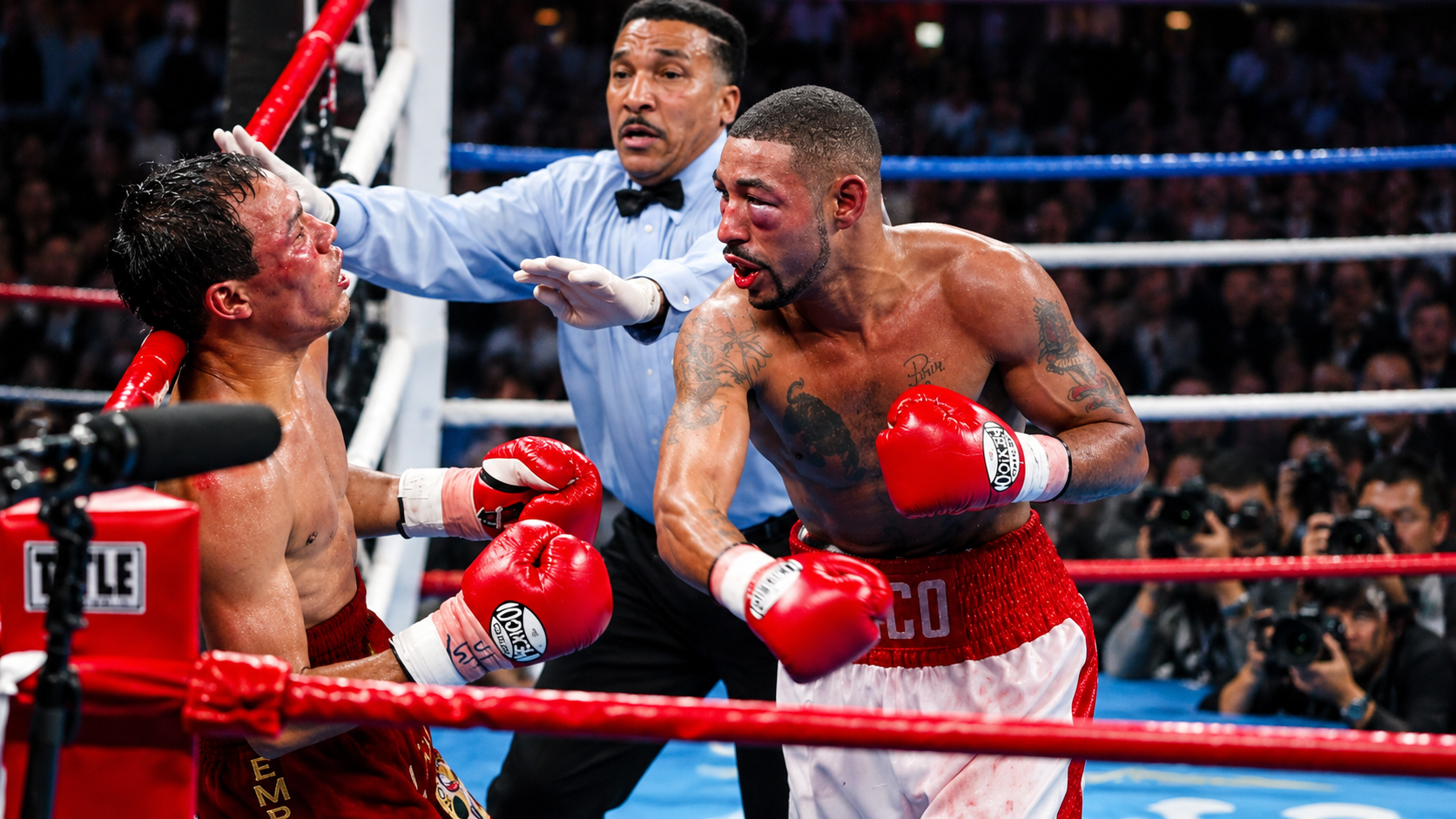
Early in round ten, Castillo landed a left hook and dropped Corrales. Corrales's mouthpiece came out. He rose during referee Tony Weeks's count and gained additional recovery time while it was replaced. Castillo attacked again and dropped him a second time.
Corrales deliberately removed his mouthpiece. Weeks deducted a point. The incident remains part of the controversy surrounding the fight: removing the mouthpiece bought Corrales valuable seconds. The referee penalised him for it.
But Corrales still had to get up, and he did.
Castillo moved in expecting to finish him. Instead, Corrales suddenly landed a huge shot that stopped Castillo's advance. The momentum reversed almost instantly. Corrales followed with combinations and drove Castillo towards the ropes.
Castillo was hurt and no longer defending himself effectively. Weeks intervened. The official time was 2 minutes 6 seconds of the tenth round.
Corrales had been knocked down twice, penalised a point and appeared seconds from defeat. He had nevertheless stopped Jose Luis Castillo in the same round.
The bout was named the 2005 Fight of the Year by both The Ring and the Boxing Writers Association of America. It became one of the defining fights of its generation. It was also the final victory of Corrales's career.
★ Diego Corrales ★
The Rematch and the Trilogy That Never Happened
A rematch took place on 8 October 2005. The build-up was damaged when Castillo failed to make the 135-pound lightweight limit, weighing 138.5 pounds. Corrales agreed to proceed in a non-title contest.
This time Castillo stopped Corrales in the fourth round.
A third fight was arranged for June 2006. Once again Castillo failed to make weight, this time by a much larger margin, and the bout was cancelled. One of boxing's most compelling rivalries therefore ended 1-1 rather than with the deciding fight the sport expected.
★ Diego Corrales ★
The Final Fights
Corrales returned on 7 October 2006 for a third meeting with Casamayor. This time Corrales himself failed to make the lightweight limit. Casamayor won a 12-round split decision.
On 7 April 2007, Corrales moved up to welterweight to face Joshua Clottey. Clottey dropped him in the ninth and tenth rounds and won a unanimous decision.
Corrales's record was now 40-5. Nobody knew that the Clottey fight would be his last.
★ Diego Corrales ★
7 May 2007
Exactly one month after the Clottey fight, Corrales was riding a 2007 Suzuki GSX-R1000 motorcycle in Las Vegas.
At about 7:15 p.m. on 7 May 2007, travelling north on Fort Apache Road near Russell Road, his motorcycle struck the rear of a Honda Accord. Corrales was thrown from the motorcycle and into another vehicle. He was pronounced dead at the scene. He was 29.
The date carried an extraordinary coincidence. It was exactly two years since his victory over Castillo.
That coincidence is haunting, but his death should not be turned into a romantic boxing metaphor. Contemporary police reporting cited speed and rider inexperience as factors. Later toxicology testing found Corrales had a blood-alcohol concentration of 0.25 percent.
Those facts are part of the story. His death was not a final heroic round. It was a preventable road tragedy that ended the life of a 29-year-old husband and father.
★ Diego Corrales ★
The Man Behind the Warrior Image
Boxing easily reduces people to identities. A fighter who repeatedly gets up becomes “a warrior”; a man willing to exchange punches becomes “fearless”. With Corrales, those descriptions contain some truth but not the whole truth.
He showed exceptional courage in the ring. He was also a complicated man who made serious mistakes outside it. His domestic violence conviction cannot be erased by championships, and the circumstances of his fatal crash should not be omitted to make the ending more heroic.
At the same time, those facts do not change what he achieved as a boxer.
Part of Corrales's fascination was his vulnerability. Mayweather dismantled him. Casamayor beat him twice in three meetings. Castillo knocked him out in their rematch. Clottey was too strong for him in his final fight.
With Corrales, defeat was always imaginable. So was recovery.
That is why the first Castillo fight represents him so well. In ten rounds it contained skill, punishment, recklessness, controversy, vulnerability and an astonishing refusal to accept the direction in which the fight appeared to be heading.
★ Diego Corrales ★
Legacy
Corrales died before anyone could know what the next stage of his life would have been.
What remains is a 45-fight professional career: 40 wins, 33 knockouts and world championships at super-featherweight and lightweight.
There are the individual nights: Roberto Garcia, Mayweather, the Casamayor trilogy, Freitas and, above everything, Castillo.
Corrales-Castillo I needs little embellishment. Two elite lightweights fought at close range for nine punishing rounds. Corrales was dropped twice in the tenth. He lost a point for removing his mouthpiece. Castillo moved in to finish him. Corrales hurt Castillo, drove him to the ropes and forced the stoppage at 2:06.
Two years later, to the day, Corrales was dead. In 2024, the International Boxing Hall of Fame inducted Corrales, formal recognition that his relatively short career had left a permanent mark on the sport.
★ Diego Corrales ★
Remembering Chico
The temptation is to finish Diego Corrales's story with the tenth round against Castillo. It provides the perfect sporting image: a beaten fighter rising again and winning when defeat appeared certain.
Real lives do not end as neatly as sports stories.
Corrales's includes championships and prison, great victories and serious wrongdoing, courage and recklessness, a famous comeback and a death that came decades too soon.
Remembering all of it does not diminish the story. It makes it truthful.
Diego Corrales was not undefeated and he was not flawless. He was a gifted, ferocious and deeply compelling boxer whose best nights captured something elemental about boxing: what remains when technique and tactics have been exhausted and both fighters are being asked questions they cannot answer comfortably.
On 7 May 2005, Corrales found an answer when almost nobody watching expected him to. That night became his sporting immortality. Two years later, boxing lost him at 29.
The tragedy is not that a fighter who always got up finally could not. That turns a real man's death into a boxing line.
The tragedy is simpler. He was still young. His fighting career had barely ended. He had a family and a life beyond the ropes that should have had many years left to run.
What survives is the record, the footage and the memory of Chico — a fighter who, on one extraordinary night in Las Vegas, produced a comeback that boxing has never stopped replaying.