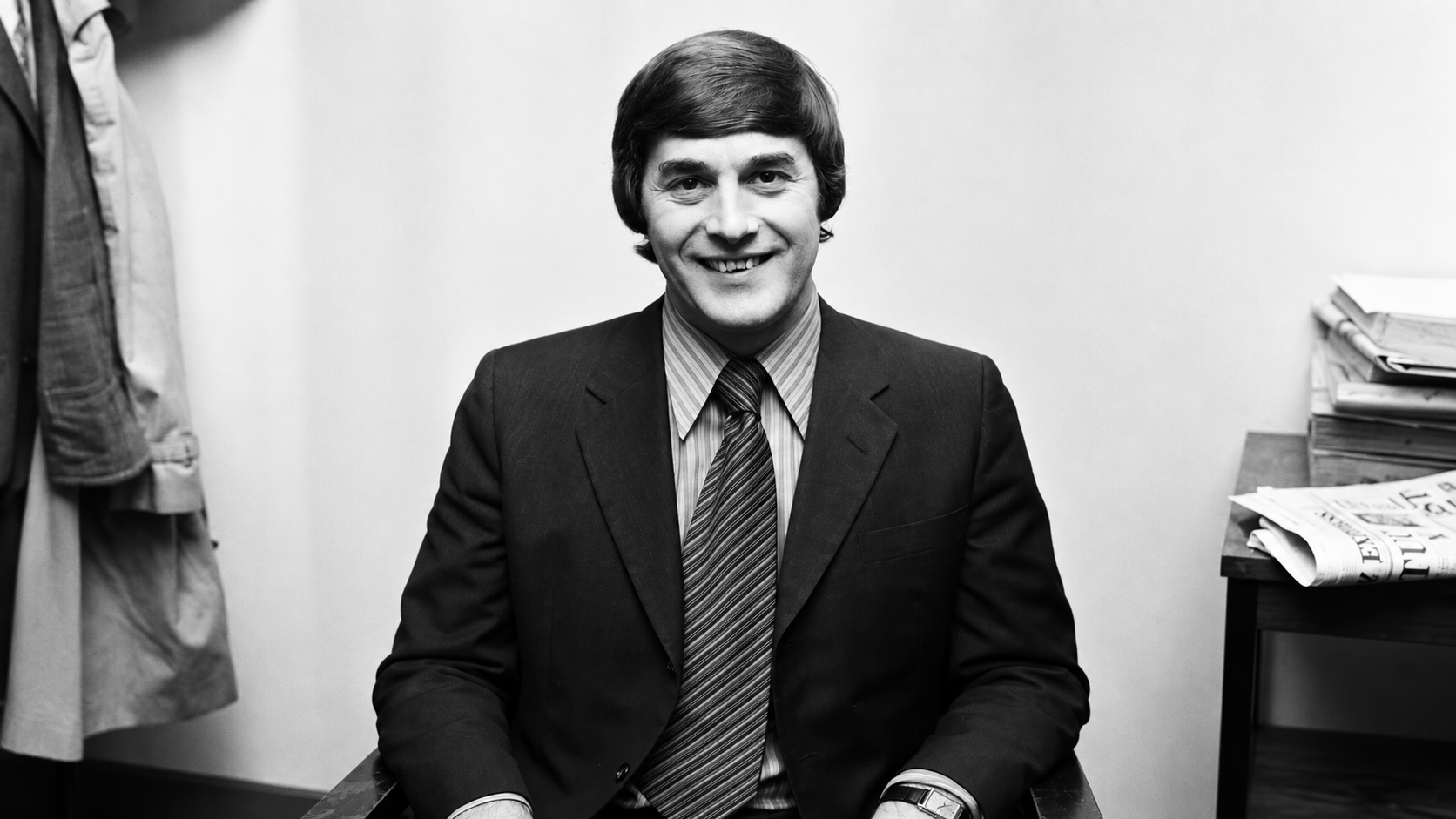
The hard old-school reporter who became one of the fight game's most loved figures.
George Foreman died on 21 March 2025. Colin Hart died the following day. For anyone who knew the history between them, the timing felt almost impossibly neat.
Half a century earlier, Foreman had been the most frightening heavyweight in the world and Hart a chain-smoking British boxing writer standing beside a hotel swimming pool in Caracas. Foreman was preparing to defend his title against Ken Norton. The British press had finally been granted an audience with him, and Hart was smoking. “Hey you! Put that out,” Foreman ordered. Hart looked at the heavyweight champion and answered: “Say please.”
He could irritate people, challenge them and sometimes fall out with them. Yet fighters and promoters who had once been furious with him often ended up respecting him, and many became genuine friends.
Hart spent more than half a century reporting on men who fought for a living. He approached journalism with something of the same mentality: prepare properly, stand your ground and tell the truth as you see it. That could make him difficult. It also made him loved.
★ Colin Hart ★
Boxing Before Journalism
Colin Hart was born in West Ham, East London, on 6 April 1935. Boxing was part of his family culture long before it became his profession. His father told him stories about the great Jewish fighters of the East End, particularly Ted “Kid” Lewis. When Colin was ten, his maternal grandmother took him to his first professional show at West Ham Baths.
He boxed himself at school and youth-club level but quickly discovered that admiration for fighters and talent for fighting were different things. His later explanation was characteristically uncomplicated: he became tired of getting nosebleeds.
His childhood heroes were Joe Louis and Sugar Ray Robinson. American boxing existed for a London boy largely through newspapers, radio and cinema newsreels. Hart could not have imagined that he would eventually interview the men he read about, or that one day he would sit at Madison Square Garden waiting for Muhammad Ali and Joe Frazier while an entire arena rose to applaud Joe Louis walking to his seat.
That distance — from a boy at West Ham Baths to press row at the biggest fights on earth — is the real scale of Hart's career.
★ Colin Hart ★
Learning The Trade
Hart entered journalism as a teenager and developed through the old agency and newspaper system before joining the Daily Herald. By the early 1960s he had moved into sport and was learning boxing reporting from the bottom. At major London shows he was the junior man, going to dressing rooms after fights, collecting quotations and hurrying back to ringside so the senior boxing writer could use them.
It was an education in an era when reporting required physical presence. There was no internet, instant transcript or mobile phone. Hart described covering long championship bills while dictating running copy by telephone to a copytaker sitting at a typewriter. Once a fight ended, he dictated a considered rewrite, collected reaction and began again for the next contest. On a major night he might effectively occupy a telephone from eight in the evening until midnight.
The habits stayed with him. Even decades later, when reporters around him carried smartphones and laptops, Hart remained recognisably Fleet Street: notebook, telephone, memory, contacts and the expectation that a journalist should know his subject before offering an opinion.
★ Colin Hart ★
The Sun And The Fight Of The Century
When the modern Sun was launched in 1969, Hart became its boxing correspondent. He would hold the full-time position for 31 years before retiring from that role in 2000, then continue writing a column for another quarter of a century.
His first American assignment could hardly have been larger: Muhammad Ali against Joe Frazier at Madison Square Garden on 8 March 1971. Both were unbeaten. Each had a legitimate claim to the heavyweight championship. Celebrities filled the building.
Hart remembered something quieter. Around twenty minutes before the fighters were due in the ring, the Garden suddenly began to rise. Applause spread through the building. Hart initially had no idea what had happened. Then he saw Joe Louis making his way towards his ringside seat. Louis had been one of Hart's boyhood heroes, and more than 20,000 people were now standing for him. Hart later said the moment made the hairs on the back of his neck rise.
Then Ali and Frazier fought for fifteen rounds, Frazier dropped Ali with the great left hook in the final round, and Hart's first American assignment became one of the most famous fights in history. It was an absurdly high starting point. Remarkably, the career kept finding larger occasions.
★ Colin Hart ★
Caracas: “Say Please”
Hart looked at the heavyweight champion and answered: “Say please.”
By 1974, George Foreman was the most frightening heavyweight in the world. Hart was a chain-smoking British boxing writer standing beside a hotel swimming pool in Caracas, where Foreman was preparing to defend his title against Ken Norton. The British press had finally been granted an audience. Hart was smoking. “Hey you! Put that out,” Foreman ordered. Hart looked at the heavyweight champion and answered: “Say please.”
It was a ridiculous thing to say to George Foreman in 1974, which is precisely why it tells us so much about Colin Hart. He was not trying to be brave. He simply disliked being ordered about. He was an East End reporter, already hardened by newsrooms and press boxes, and the fact that the man doing the ordering could knock out heavyweights for a living did not alter the principle.
The interview deteriorated when Hart questioned Foreman's pride in his recent destruction of José Roman. Foreman's enormous hand began moving in Hart's direction before publicist Bill Caplan intervened.
Years later the two men met again. Foreman had changed enormously after losing to Ali. Hart was standing in a hotel lobby smoking when the familiar voice arrived behind him: “Hey you! Put that out.” This time Foreman was smiling. The joke ended the feud. They became friends. In 1995 Foreman gave Hart a signed copy of his autobiography with another reminder to put out the cigarette.
★ Colin Hart ★
Kinshasa And The One Time He Was Unprofessional
When Foreman agreed to fight Ali in Zaire, much of the boxing press feared for Ali. Foreman was younger, stronger and had demolished men who had given Ali terrible nights. Hart began to doubt the obvious conclusion. He later recalled discussing the fight with the respected American writer Bob Waters, admitting he had a feeling Ali might win. Waters agreed and pointed to an earlier Foreman fight against Gregorio Peralta, when the heavyweight had appeared exhausted late. Hart committed himself: he picked Ali and predicted a late stoppage.
In Kinshasa, the event became unlike anything Hart had covered. Ali had captured the local population. The fight was delayed after Foreman suffered a cut, extending the strange African camp and the sense that normal boxing rules no longer applied.
Then Ali did what almost nobody expected. He allowed Foreman to punch himself towards exhaustion, countered from the ropes and stopped him in the eighth round. Hart had predicted the upset, although he later freely admitted he had imagined Ali using movement rather than the rope-a-dope tactics that actually unfolded. When Foreman went down, Hart jumped from his ringside seat punching the air. He later called it the first and last time he behaved unprofessionally at ringside.
For Hart, Ali-Foreman remained the most extraordinary boxing event he ever covered. It was not, however, the best fight he ever saw.
★ Colin Hart ★
Fifteen Rounds Of Boxing Perfection
That distinction belonged to Roberto Durán and Sugar Ray Leonard in Montreal in 1980. Hart was ringside when Durán challenged Leonard for the WBC welterweight championship. He watched the psychological battle before the contest and then the extraordinary tactical fight itself: Leonard choosing to engage, Durán forcing him into uncomfortable exchanges, two elite fighters producing fifteen rounds without a knockdown and with barely any separation on the scorecards.
Decades later, when asked to name the finest fight he had seen, Hart still chose Leonard-Durán I. His description was wonderfully economical: “15 rounds of boxing perfection.”
It is an important choice because Hart had seen almost everything. He was at Ali-Frazier I, the Rumble in the Jungle and the Thrilla in Manila. He saw Leonard, Durán, Hagler and Hearns in their primes. He covered the Tyson era, Holyfield-Bowe and the infamous Tyson-Holyfield rematch. The great fights were not documentaries to him. They were nights at work.
★ Colin Hart ★
Ali Away From The Lights
Years after Muhammad Ali retired, Hart was in Las Vegas to cover Julio César Chávez against Edwin Rosario and to interview the young heavyweight champion Mike Tyson. Ali, by then diagnosed with Parkinson's disease, happened to appear near a newsstand. Hart spoke to him and expressed sympathy about the illness. Ali replied: “I'm a man, not a god.” He added that he was not afraid to die.
Hart understood immediately that an unplanned conversation had become a story. When Ali walked away, he hurried back to his hotel room and wrote down everything he could remember before the words disappeared. The conversation became a major Sun exclusive.
The episode contains almost everything Hart valued about reporting. There was no press conference, no publicist arranging five questions and no recording sent afterwards. He happened to be there. He knew the significance of the man in front of him. He listened, remembered and recognised the story. For Hart, journalism was not merely writing well after an event. It was noticing the event while it was happening.
★ Colin Hart ★
Hard, But Not Heartless
Hart's reputation for bluntness could suggest a man permanently looking for an argument. The people who knew him described something more complicated. Frank Bruno knew Hart from his amateur days, and their relationship grew beyond reporter and fighter. When Bruno fought at Wembley, he sometimes slept at Hart's home during the afternoon before a contest. On one occasion Bruno tried to close the curtains and accidentally pulled the curtain rail from the wall. Hart's wife supplied the obvious explanation: Frank did not know his own strength.
During Bruno's later struggles he turned to Hart for support. After Hart died, Bruno remembered not merely a reporter interested in a headline but somebody who cared what happened to fighters after the crowd had gone home. He called Hart the “undisputed champion” of boxing reporters.
Michael Watson expressed the same idea from a different direction. Hart had reported on Watson as a fighter and remained concerned about him after the catastrophic brain injury suffered in his 1991 rematch with Chris Eubank. Watson remembered a boxing man who cared about fighters and made him feel that Hart was in his corner.
★ Colin Hart ★
The Deaths That Stayed With Him
Among the experiences Hart found hardest were deaths following fights. One that remained with him was the Italian middleweight Angelo Jacopucci, who fought Alan Minter for the European title in 1978. Hart remembered seeing Jacopucci at the post-fight reception, talking and laughing. Three days later he was dead from injuries suffered in the contest.
For a journalist who loved boxing, these moments created an unavoidable contradiction. Hart could celebrate courage and great fights while understanding that the same sport could permanently damage the people providing the spectacle. He regarded improvements in ringside medicine and medical supervision as among the most important changes he witnessed during his lifetime in the sport.
This is important to understanding why fighters could trust a journalist who was often hard on them. Hart was capable of criticising a performance without losing sight of the human being performing it.
★ Colin Hart ★
Frank Warren: From Adversary To Old Friend
Perhaps no relationship better explains Hart's character than the one he developed with the promoter Frank Warren. When Warren entered British boxing around 1980, Hart did not welcome him. Hart was close to the established promotional order around Mickey Duff and regarded the younger Warren as an upstart disrupting a world he knew. Warren later acknowledged that they did not begin as friends, and for a period they were not speaking.
That could easily have become a permanent Fleet Street feud. It did not. Time, argument and shared decades in boxing changed the relationship, and the two men eventually became close personal friends. The transformation says something about both men, but particularly about Hart. He could attack somebody's position without requiring lifelong personal hatred afterwards.
★ Colin Hart ★
Lennox Lewis And The Right To Be Wrong
He wanted to get to the truth and tell the truth.
Hart was initially sceptical about Lennox Lewis and unconvinced by some of the Canadian-raised Olympic champion's early professional claims. Lewis remembered the criticism. He also remembered using it. As Lewis developed into the leading heavyweight of his era, Hart changed his assessment. There was no value in a boxing writer clinging to an old opinion simply to avoid admitting he had been wrong.
After Hart's death, Lewis remembered him as the leader of the boxing press pack and praised the quality at the centre of Hart's work: he wanted to get to the truth and tell it.
That willingness to disagree did not stop at fighters. After Lewis and Evander Holyfield fought to a controversial draw in 1999, Britain erupted. Lewis appeared to most observers to have done enough to win. Hart scored the fight a draw. British readers were furious, he was abused, and calls were made for him to be sacked. He did not change his card because the national mood demanded it. A journalist who only speaks bluntly when the crowd agrees with him is not especially brave.
★ Colin Hart ★
A Press Box That Became A Family
Boxing journalism in Hart's prime was fiercely competitive. National newspapers travelled in numbers and every reporter wanted the line, the exclusive or the quotation the man in the next seat had missed. Yet the press pack also spent extraordinary amounts of time together: airports, hotels, taxis, training camps, weigh-ins and the dead hours before a fight.
Norman Giller, who knew him from their East London newspaper days, remembered Hart as the best-informed boxing reporter of them all. Freddie Burcombe, a rival from the News of the World and later a close friend, remembered the animated arguments and the depth of Hart's knowledge. Gareth A Davies called him a mentor and described a near-photographic memory capable of reaching back across six decades of boxing.
That memory mattered because boxing is a sport unusually vulnerable to forgetting. Every new champion is advertised as unprecedented. Every dramatic fight is called the greatest ever. Hart had actually seen enough of the old ones to test those claims. There was affection beneath the combat: arguments were part of membership rather than evidence that membership had ended.
★ Colin Hart ★
More Than Boxing
Boxing made Hart famous, but it was not the only sport he understood. He covered eight Olympic Games and wrote on athletics, football, motor racing and other sports. He was also a devoted West Ham United supporter, and friends remembered that devotion with amusement. Hart could be thousands of miles away in Las Vegas preparing to cover a world-title fight and still organise his day around discovering West Ham's result.
Freddie Burcombe, who sat near him at West Ham matches, wrote after Hart's death that games would not feel the same without the familiar post-match dissection on the walk to the station. The Hall of Fame journalist who had interviewed Ali and Foreman was still an East End football supporter capable of having his mood altered by West Ham. The East End never really left him.
★ Colin Hart ★
Recognition From The People Who Understood The Job
In 2011, the Boxing Writers Association of America selected Hart for the Nat Fleischer Award for Excellence in Boxing Journalism. He became the first British writer to receive it. The honour mattered because it came from a country whose boxing writers he had worked beside for decades and whose press rooms he had entered first as a visiting English reporter.
Two years later, he was inducted into the International Boxing Hall of Fame. The symbolism was considerable. The ten-year-old boy taken by his grandmother to West Ham Baths now had his name permanently recorded in the same institution that honoured the fighters he had spent his life covering.
Journalists normally write other people into history. By then, Hart had become part of boxing history himself.
★ Colin Hart ★
Retirement That Never Really Happened
Hart retired as The Sun's full-time boxing correspondent in 2000 at 65. In most professions that would have been the end of the working story. For Hart it merely changed the job description. The paper offered him a column and he accepted, continuing for another quarter of a century.
Newspapers changed, boxing changed and journalism changed almost beyond recognition. The smoky Fleet Street world in which Hart learned the trade disappeared. Copytakers vanished. Print circulations declined. Press conferences became livestreams. Fighters began speaking directly to audiences through social media. Hart kept writing.
His value increasingly came from perspective. When a new champion was declared an all-time great, Hart had actually watched many of the all-time greats from ringside. His byline remained in The Sun until only weeks before his death. The full-time correspondent had retired in 2000. Colin Hart, boxing writer, never really did.
★ Colin Hart ★
The Old Ways And The New Generation
Hart never completely modernised because he did not believe every modern convenience improved the work. Famously, he never adopted the mobile phone in the way almost everyone around him did. Younger reporters found the refusal extraordinary. He had spent his formative years dictating copy down telephone lines to copytakers and did not regard constant electronic availability as essential to journalism.
What mattered to him was being there. He went to gyms. He knew trainers. He spoke to fighters away from formal press conferences. He had spent so long around boxing that the sport's history was not an archive he consulted but a sequence of rooms he had actually occupied.
Age did not make him protective of that knowledge. In 2021 Hart spent several hours with young England Boxing athletes in London. They watched Leonard-Durán I with a man who had actually been sitting at ringside in Montreal. He talked about Ali, Hagler and Hearns, but also gave practical advice. One message particularly stayed with the young boxers: do not rush to turn professional; learn the trade in the amateurs first.
★ Colin Hart ★
What The Tributes Revealed
When Hart died, the tributes came from almost every corner of British boxing. Frank Bruno remembered friendship and support. Lennox Lewis remembered truthfulness. Michael Watson remembered care. Joe Calzaghe, Ricky Hatton and others remembered a journalist who had been present through their careers. Michael Buffer paid tribute to a man who had been there long before the elaborate entrances and global broadcasts.
The variety matters. If Hart had merely been famous, the tributes would have listed the fights he covered. Instead, people repeatedly described what he had been like to know.
Hart could be hard. He could be stubborn. He could write something a fighter hated and defend it when challenged. He was not trying to become everybody's friend. Yet friendship kept happening, perhaps because the people around boxing understood the difference between criticism and betrayal. His relationships survived because people generally knew where they stood. The toughness was real. So was the loyalty.
★ Colin Hart ★
The Final Telephone Call
A few weeks before his death, Hart knew time was becoming short. He called Frank Warren. There is something fitting about Warren being one of the people Hart chose to contact. Their relationship had begun in suspicion and hostility. They had argued, fallen out, stopped speaking and eventually become close. Now the old journalist wanted his friend to know what was happening.
Warren later wrote that Hart was not feeling sorry for himself. He was preparing to write his final Sun column. More than his illness, he spoke about feeling blessed: blessed by his family and by the profession in which he had spent his life.
It would be easy to make that conversation more sentimental than it apparently was. Hart was not a man given to melodrama, and that restraint makes it more affecting. A journalist who had spent decades asking other people how they felt at the most important moments of their lives had reached one of his own. His response was gratitude.
★ Colin Hart ★
The Last Coincidence
Hart died peacefully on 22 March 2025, aged 89, with close family around him. George Foreman had died the previous day.
The coincidence immediately returned people to Caracas: Foreman ordering the cigarette extinguished, Hart demanding manners from the heavyweight champion, the huge hand beginning to rise and Bill Caplan stepping between them. Both men had changed enormously since that afternoon. Foreman had lost to Ali, undergone a religious conversion, left boxing, returned after a decade, regained the heavyweight championship at 45 and transformed his public image from terrifying destroyer to genial elder statesman.
Hart had travelled the other route around the ring. The cocky East End reporter became the elder statesman of the British boxing press, still opinionated but increasingly valued as a living connection to the sport's past. Two men from entirely different worlds had spent their lives around boxing and died within a day of one another. Even Hart, who distrusted overstatement, might have admitted that the ending had a certain symmetry.
★ Colin Hart ★
Why Colin Hart Mattered
Colin Hart did not throw a punch in any of the great fights he covered. He did not promote them, train the fighters or announce the results. He watched. Then he told people what he had seen.
That sounds modest until one considers how much of sporting history survives through witnesses. Fights become grainy footage and statistics. The atmosphere disappears first: the fear around Foreman, the electricity when Joe Louis entered Madison Square Garden, the absurdity of a 4am fight in Zaire, the mood in a dressing room, the sentence Ali said beside a newsstand when nobody had arranged an interview. Hart carried those details.
He also represented a particular idea of sports journalism. Access mattered, but independence mattered more. Friendship with fighters did not require flattering them. Being British did not require scoring every close fight for the British boxer. Being experienced did not mean pretending never to have been wrong.
His career stretched across an almost impossible period of boxing history. He began when Sugar Ray Robinson was still an active fighter. In the 1980s came Leonard, Durán, Hagler and Hearns, followed by Mike Tyson. The 1990s brought Holyfield and Lewis, while British boxing produced Benn, Eubank, Bruno and Naseem Hamed. Hart then remained in print through the careers of Calzaghe, Hatton and another generation beyond them. Most careers fit inside an era. Hart's contained several.
That may be the greatest achievement of a sportswriter. Not simply to record who won. To preserve what it felt like to be there. Colin Hart spent his life beside the ring while other men made boxing history. Somewhere along the way, without ever putting on the gloves, he became part of that history himself.